
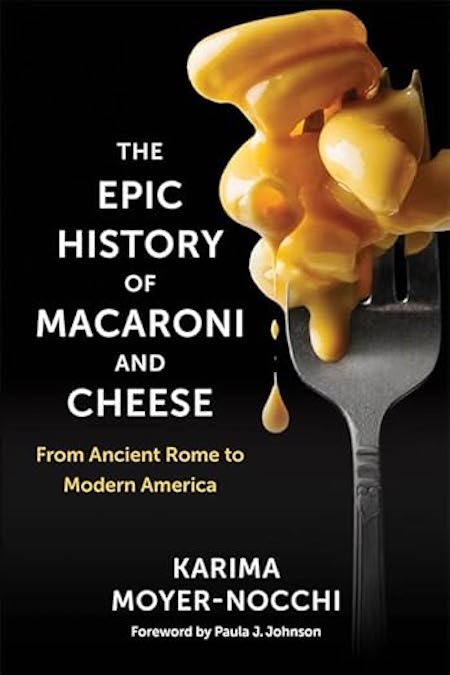


The Epic History of Macaroni and CheeseFrom Ancient Rome to Modern America
Today, macaroni and cheese is the ultimate comfort food, a staple of weeknight dinners, family gatherings, and Soul Food restaurants. Humble though the dish may seem, its history is filled with surprising twists and turns. Renaissance cardinals and popes dined on elaborate pasta-and-cheese concoctions laced with costly spices. In the eighteenth century, wealthy young Englishmen made macaroni a symbol of continental sophistication. Black women, whose contribution has long been overshadowed, played a crucial role in establishing the dish as an American tradition from the nation’s founding through the Civil Rights Movement.
This book is a delectable history of macaroni and cheese, tracing an extraordinary journey of cultural exchange and social change. Karima Moyer-Nocchi reveals the religious, political, and industrial forces that shaped its evolution alongside stories of the unsung figures who crafted the dish as we know it today: enslaved cooks who preserved and adapted traditions, immigrant chefs who introduced new variations, and practical homemakers looking to nourish their families with an affordable meal. She emphasizes the adaptability of macaroni and cheese, which in different times has served as both an indulgence on the elite table and sustenance to those struggling to survive, crossing borders, social classes, and cultural divides. Deeply researched and rich with enticing details, this book uncovers the creativity and resilience that brought a beloved food to our tables. The Epic History of Macaroni and Cheese also shares centuries of recipes—from ancient Roman authors to celebrity chefs, reworked for modern kitchens—that provide a hands-on way to experience the evolution of this iconic dish.
Karima Moyer-Nocchi is a culinary historian specializing in Italian food who teaches at the University of Siena. She is the author of Chewing the Fat: An Oral History of Italian Foodways from Fascism to Dolce Vita(2015) and The Eternal Table: A Cultural History of Food in Rome (2019).
Paula J. Johnson is curator of food history at the Smithsonian National Museum of American History.
Karima Moyer-Nocchi
Macaroni and cheese is a long-serving comfort food. One that the vast majority of us are quite familiar with. Its omnipresence in our lives has made us take it for granted. We have overlooked that this dish has a long and fascinating history. University of Siena professor Karima Moyer-Nocchi tells us about the history of macaroni and cheese that she has documented in her latest book The Epic History of Macaroni and Cheese.
~~~~~
Books About Food (BAF:): I’m curious, let’s start at the beginning. What drew me in was the title because while I mean this with all due respect, you don’t really associate mac and cheese with the word ‘epic’, which I thought was a terrific title.
Karima Moyer-Nocchi: Exactly. Yes. So it’s surprising because it seems like something that’s light in the ‘LITE’ sense, whereas it’s actually been embroiled in history and can be traced back to ancient Rome. So that’s where I begin. But what fascinated me about it was how it interweaved then with so many issues in history that were very decisive about where we were moving socially and politically, economically. And just how macaroni and cheese and the dish followed that along. It upped through becoming then an American culinary icon.
BAF: Where did the idea come from to do a book? Because what we touched on is that mac and cheese has always sort of been there. Where was your light bulb moment that this could be something worthy of a book?
Karima Moyer-Nocchi: Well, it had started as a COVID project, something because Italy was the first country to go into lockdown over COVID. And from one weekend to when we were told on a Friday, I teach at the University of Sienna. We were told on a Friday that on the next following Monday, we would be teaching from home. And we all sort of went into shock students included, who were very angry about being home with their parents. And we went through a very miserable semester together. And I needed something to kind of bring me out of that, distract me, capture my interest. And I created this course, which was the Italian origins of macaroni and cheese. I did this as an online course, and then unbeknownst to me, the librarian at Monticello, and we all know that Monticello is very important for their supposed history with macaroni and cheese involving Thomas Jefferson and his enslaved chef, James Hemings.
So I ended up getting invited there, but they wanted me to expand the conversation. And in my presentation, I had brought the topic in through France and England, England and then France, actually, and slightly over to the colonies and they wanted me to expand that. And as I did that over the course of a year before I actually went and did the presentation, I discovered really how involved in history the dish was, its passage with triangular trade and the slave trade, the change of ingredients and the story that there was to tell behind all of that.
BAF: Well, I think you alluded to a question I had planned for further down is where did this take you and what surprises did it show you?
Karima Moyer-Nocchi: Many surprises along the way. One important one, I think, let’s see, of where it took me as again, the dish moves into England relatively early. So already in 1390, we find a recipe for macaroni and cheese in an English cookbook. The dish was at that time an elite dish. So it had been on the papal table, very much part of the aristocracy and the elite, the high clergy, and that’s how it moved along. So a dish needs to be aspirational to have some sort of meaning in order for it to move on and then persist. So it attained that meaning and then the meaning continued to change and people, for example, in France began to began to identify it as well. When France took over the center of culinary culture, so they became the arbiters of taste, and that’s happening in the 17th century. They slowly were taking macaroni, which was originally an Italian dish, into their inner sanctum of what was going to represent elite French cooking.
The English then who already had macaroni and cheese were then imitating that. The dish would then travel over to the colonies. So it’s really moving around quite a lot. But one of the things that you said to me was what was something that was surprising is to find that it also went to the Caribbean. Now, in the Caribbean, it would go on to become and is today the national dish of Barbados. In the Caribbean islands, you will find macaroni and cheese throughout. And that’s very much about the history of triangular trade, Europe, Africa, the Americas, and how those ingredients traveled around.
The Caribbean was a way station for the African slave trade. Sleeves would be what was called ‘broken’ there, and then it transferred up to North America, to the North American colonies, or into North America when it became the early United States. So what you’ve got there then is the transfer of ingredients. Now, what’s interesting to find then in all of this going around and mixing around, is that the first recipe for macaroni and cheese with kain pepper, which is coming from that triangular trade, is going to appear in Scotland in a recipe, in 1795, very early, in a recipe for a pie. So it’s a macaroni pie in Scotland with Cane pepper. And then meanwhile, going back to Barbados, they have a thing called macaroni pie, which is crustless, but it’s called pie because it’s relatively solid, baked in a dish. You cut it into these sort of squares, and they call that just pie.
So it’s so ubiquitous there that it’s just called pie. So those are the kinds of things that really fascinate me about culinary history, about this dish, where it’s been, where it goes, and who absorbs it into their culinary identity.
BAF: Very intriguing about its links to the Caribbean. I guess we have to thank the Colombian Exchange for that. And it’s curious as to its connection to Scotland with cayenne pepper, because Scottish food is not known to be overly spicy, and particularly being the national dish of Barbados, I think you said.
Karima Moyer-Nocchi: The national dish of Barbados, it’s also very well known in Trinidad and the Bahamas. So throughout the Caribbean, it’s an important dish, but macaroni pie is also part of the culinary landscape, so not necessarily at the level of hagies, for example, in Scotland, but it is considered one of their national dishes along with you’ve got your scotch pie, macaroni pie, and other Scottish dishes.
BAF: And I have not tried it, but I have seen deep fried macaroni and cheese in Scotland available.
Karima Moyer-Nocchi: Okay. Yeah. It’s very important there.
BAF: Well, curious about the Caribbean. When it was transferred over there, was it still a dish for the elite or was that coming down to the grass to the slaves, or was that food for slaves or the common, or was that still an elitist dish?
Karima Moyer-Nocchi: It would remain an elitist dish until the middle of the 19th century. So when it gradually would start to change, but it remained so because of what was going on in culinary fashion in England and France. England and France were the point of reference for the colonists. They were in a diaspora like anyone else, always looking over to England and France for their fashion cues, their culinary cues, social cues, how to behave. And as far as the table goes, what to cook, how to prepare it, and how to serve it, and how to act while you’re eating it, very much dictated. So while Americans were becoming Americans, that fashion was still dictated very much by England and France. That same thing is going to happen in the Caribbean, where they’re trying to create a verisimilitude of what they feel like colonial elites should be wearing and acting, and how they should be acting, and what they should be eating.
It remains an expensive dish because that macaroni is being imported. It’s an imported food item, and that keeps it expensive and very much part of ostentatious display.
BAF: Certainly all the governors and the people who ran the place wanted to bring English society over. So certainly it does make sense.
Karima Moyer-Nocchi: So just for example, the governor of the Bahamas, after Lord Dunmore, who was Scottish, he was the last royal governor of Virginia. During the American Revolutionary War, he goes back to England, but then he becomes the governor of the Bahamas. So you’ve still got that same kind of trade going on. And again, then you end up with a Scottish macaroni pie with cane pepper. Cayenne, I believe it’s called.
Oh and just we had one little extra thing. Of course. Just the name of the pepper, the habanero pepper, as we know habanero, the scotch bonnet, scotch bonnet, which is the shape of what’s called a tamoshanter, which is a Scottish kind of hat, all of that kind of thing going on. Okay. So yes.
BAF: Well, that’s the beauty of culinary history, the connections and how everything is interwoven without even people realizing it.
Karima Moyer-Nocchi: Absolutely. I love the expression coined by a friend of mine, ‘history was written as if no one ever ate’, which gives culinary historians lots of ground to be producing books like this so that because it’s a relatively new field, we’re not yet hair splitting in the way that other scientific fields are.
BAF: I was curious about the governor of Virginia who brought over the macaroni and cheese to the Caribbean. Did he have any connection with Jefferson? Did he learn about the dish through Jefferson or meeting Jefferson?
Karima Moyer-Nocchi: Well, okay. So when he was the royal governor, I dedicate an entire chapter to a Jefferson. I ended up having a fellowship at Monticello so that I could closely examine and deconstruct the mythology, the history, the gastromyth of Thomas Jefferson, and how that was transferred on then to James Hemmings, his enslaved chef, and how that whole story got started because macaroni and cheese was already, and I cover this thoroughly in my book, it was already in the colonies before Jefferson had even left for Paris, there is evidence that Jefferson himself would’ve eaten it at a favorite tavern that he went to, which was owned by an Italian man who would have been creating the dishes from England and France that were on the proper elite table. So there was that. Also, that particular governor of Virginia, James Murray, the fourth Earl of Dunwore, while he was there in 1773, he had ordered a shipment of macaroni and a good amount of Cheshire and Gloucester cheese to Virginia.
There are newspapers that abound with orders for macaroni and cheese already in the 1770s coming over to the colonies. And I talk about the important thing aspect there is a thing called macaroni fashion, which is a longer conversation, but macaroni and cheese was known, it was legible, there were culturally legible is what I mean. And by the 1770s, it was already being imported and I realized that people don’t always follow Jefferson in his movements. He returned from Paris in 1789. So it was a done deal by that time.
BAF: Well, maybe I should backtrack a little maybe. When you started this project, did you have a definition of macaroni and cheese that you wanted to work within, or did that expand in any way?
Karima Moyer-Nocchi: Well, it defines itself really early on. So in the Middle Ages, macaroni was an umbrella term and it was all of the shapes except vermicelli, vermicelli and ravioli, which is a stuffed pasta. There weren’t a whole lot of other shapes. So we’re basically talking about the gnocchi shape, noodle shapes, a lasagna, a proto lasagna shape, which is about a sheet of dough about the size of the palm of your hand. So you’ve got that size and also handmade macaroni, which is going to be hollow. You take a piece of dough, roll it up onto a metal rod, remove the rod, and there you’ve got macaroni. But again, this is not something that is associated with rustics or the cucchina poverta, as it’s called, poor cuisine. When you’re talking about rolling up on a metal rod, every single bite that is going into someone’s mouth, this is a very laborious dish, and that shape was very curious as well.
First of all, it’s going to hold a sauce very nicely, goes inside, and then the mouth feel of it, the curiosity of having this little piece of dough that’s been rolled out and is hollow. So there’s a lot going on there of why that piece would end up being called of macaroni. And the other pieces like lignocchi, they would go their own way, noodles would go their own way et cetera. But for a very long time, all of it was called macaroni. But the thing is that you’re not talking about just calling another word for pasta, because the only way of making pasta was with cheese. There weren’t a lot of sauces, you didn’t have your tomato and all of that for a very long time up until the 19th century. So the way to make pasta, and which was called macaroni, was with cheese in some sort of way.
BAF: People, including myself, forget that the tomato was not indigenous or historically connected for such a great length of time to Italian food.
Karima Moyer-Nocchi: Yeah. So the tomato goes over to arrives in Italy, 1544, and does not enter into the culinary grammar. It doesn’t make sense in what they’re eating and how they’re eating. It doesn’t make sense for filling the stomach of the poor. It’s not really a fruit. It’s not really a vegetable. What is this thing? It doesn’t have a place for a very long time and is basically ignored for a good amount of time until we get up to the 19th century.
BAF: Well, I think people were afraid of it originally. I think it was something to do with the nightshade…
Karima Moyer-Nocchi:That it’s part of the nightshade family, et cetera. Right. Yeah.
BAF: So you have macaroni macaroni and cheese sitting on these grand tables. How and roughly when did the transition take place?
Karima Moyer-Nocchi: So the transition is going to take place while a lot of other things that are layered are going on at the same time. So socially and politically what’s going on is that you’ve got what’s called the springtime of the peoples and there’s a lot of social division. There’s a great exodus from a lot of rioting in Europe, a great exodus into the United States then from Europe. There are a lot of talk about social reform, but importantly, it’s the middle classes, a growing middle class that is talking about social reform for the lower classes because they really didn’t have anyone in power who was speaking for them. So while that’s going on, innovations in industry are happening as well. You’ve got the hydraulic press coming in and other ways of manufacturing pasta.
In addition to that, you’ve got the discovery, I’m putting that in air quotes, because the idea of it had happened earlier, of gluten. Now, gluten, unlike the way people think of it today, where it’s got such bad connotations around it, in gluten, everyone wants to be gluten free. Well, it was completely the opposite. Gluten was the miracle food. Gluten was the plant version of meat, and this is the way that we’re going to bring about social reform and start finding a way to get some nutritious food to the lower classes. So we’ve got industry that’s picking up. We’ve got medicine that’s telling us gluten is going to … It was called flesh forming. So you have flesh forming gluten, and it was inexpensive. It was becoming more inexpensive and easier to transport as well, because transport systems were also changing. So much is going on in the 19th century that’s going to bring that food then to make it more widespread.
But the allure had already been established. And so that’s what’s also going to … It’s not like you’re asking people to suddenly eat acorns because you found out that they’re good for them. Acorns are not going to have an allure, whereas as macaroni and cheese always had had an allure. It had always been on the elite table. And so reformers like, if you’re familiar with Juliet Corson, a 1877, she and others, Sarah Tyson, become evangelists for getting more macaroni to the people. So it becomes pasta for the people at that point. She, in 1877, writes a cookbook during the great railroad strike called 15 Cent Dinners for Working Men’s Families, and she’s very much an advocate for macaroni in 1877.
BAF: I just love the idea of the term ‘flesh forming’. I don’t know if that would be a big cell these days.
Karima Moyer-Nocchi: Yeah, that was flesh forming, but also when we get into processed cheese, part of the sell of processed cheese was not only that it was shelf stable, you didn’t need refrigeration, it was made in a factory. And so it was much pureer, supposedly, than other cheeses, but it too was going to get the approval of the American Medical Association and be called flesh forming. So when you get that cheese on top of that flesh forming cheese on top of the flesh forming pasta, then you’ve got something that’s also really important for children. It’s going in so many different directions.
BAF: It’s fascinating how just … We think of mac and cheese just being mac and cheese. And it’s just fascinating to me…
Karima Moyer-Nocchi: Yeah. If I can add another dimension to that earlier on is that let’s say before the Protestant reformation, things like that, when that starts in, but when the calendar was very full, the Christian dietary calendar was very full with days that were meatless. Macaroni and cheese was a way that sort of abstinence fatigue that people felt, because it was considered a time of mortification of the flesh you were supposed to suffer, but people don’t like suffering. So they’re going to do without their meat, but then let’s get something else in there to substitute for that that’s going to be sumptuous and comforting and macaroni and cheese in that way, also attached to religion is going to be brought forward through time.
BAF: It’s bringing some of that flesh forming macaroni and cheese to atone.
Karima Moyer-Nocchi: Right, right. So you’ve got mortification of the flesh and flesh forming as well, right?
BAF: I may have asked this, but we may have touched on it, but when you started this project, did you have a timeframe in mind about roughly what you’re going to study or did that expand in any particular direction that the history went on? Well,
Karima Moyer-Nocchi: As I said, when I started off with the project, what I found interesting is that … Now, I live in Italy. I’ve lived here for 35 years. This is my home. You can hear from the way that I speak that I was raised and educated in the US. So what I found interesting was that Americans would say, “Oh, I didn’t realize that was Italian, that there was an Italian origin to it. ” And that’s why I originally wanted to put that course together because of the Italian origin of the dish. And then looking at France and England, here I am in Europe. Then I went through Monticello and expanded and expanded. Then when I wrote up the proposal to turn that into a book, I decided that I would draw it through all the way to modern America and then just end in present time so that it would truly be an epic history. I start in 160 BCE and then end up in the US.
BAF: And here we are. What’s next for you, if I could ask?
Karima Moyer-Nocchi: So right now, the book just came out in February 3rd, and I’m just focusing on right now doing presentations, and I’m open to invitations for presentations. And I want to mostly focus on just getting the book launched this year. I’d also like to start a newsletter. I know that everyone’s either doing a newsletter or a podcast these days, but something macaroni oriented because I have a whole bibliography of things that I didn’t put in the book. So it was definitely not scratching and clawing and trying to find things that I could piece this thing together. If anything, it was, “What am I going to leave out? ” Because there are so many interesting aspects to this. And then I’ve been involved in a … I’ve been asked to participate in a cookbook, which is something else that someone else is doing. So that would be something for fun after an epic history, being involved with a cookbook sounds like something light, frankly.
BAF: Oh, I’m sure. Thank you for your time. It’s been a wonderful chat for your time. And like I said before, best of luck!
Karima Moyer-Nocchi: Thank you. You too.

© 2026 Booksaboutfood.com
Brilliant, indulgent, and impeccably researched. Karima Moyer-Nocchi has crafted the definitive cultural biography of macaroni and cheese, tracing its journey across continents and through centuries with the precision of a historian and the warmth of a devoted cook. As a food scientist who’s never outgrown my love for this dish, I savored every insight into how something so simple became so culturally profound. Whether your interest is scholarly or purely gastronomic, every page in this book immensely satisfies. – Kantha Shelke, author of Pasta and Noodles: A Global History
Whether you are a fan of the creamy béchamel-infused mac and cheese that I remember from my childhood or a blue-box kid, The Epic History of Macaroni and Cheese has something for you. From the Decameronthrough contemporary African American versions, this book details the journey of this international and yet oh-so-American dish. (And yes, Thomas Jefferson and James Hemings do make an appearance!) It is a compelling and informative read. – Jessica B. Harris, food historian, cookbook author, and professor emerita at Queens College, City University of New York
As an African American from the South—and a lifelong mac and cheese lover—I found that Karima Moyer-Nocchi completely upended everything I thought I knew about this dish. In The Epic History of Macaroni and Cheese, she methodically traces its roots, debunks myths, and reveals its true cultural importance across the centuries. – Carla Hall, chef, author, and television host
Finally, the true story about mac and cheese! Karima Moyer-Nocchi’s writing is both entertaining and erudite; this book is a must read for pasta lovers everywhere. –Vicky Bennison, creator of the Pasta Grannies YouTube channel
At a time when culinary history can get as twisted as fusilli, Karima Moyer-Nocchi provides much-needed scholarship and storytelling. The Epic History of Macaroni and Cheese deftly and thoroughly sorts out fact from fiction about this beloved dish, and for that, macaroni and cheese lovers like me are grateful! – Adrian Miller, “The Soul Food Scholar” and James Beard Award-winning author
Along with a deep dive into the dish’s evolution, the book also features recipes that Moyer-Nocchi sees as “an invitation to experience history through your senses, to step into someone else’s kitchen and another moment in time.” – New York Times T Magazine
~ Related Books ~