
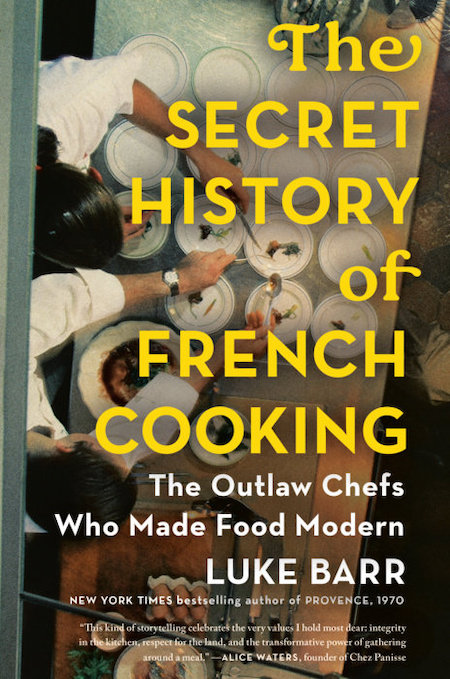


The Secret History of French CookingThe Outlaw Chefs Who Made Food Modern
From the New York Times bestselling author of Provence, 1970, a lively, dramatic account of the rise of French “nouvelle cuisine,” and the renegade chefs of the 1960s and 70s who revolutionized modern cooking.
In The Secret History of French Cooking, Luke Barr takes readers inside the culinary rebellion that upended the staid French food world and reinvented the role and cultural importance of chefs and restaurants. The very idea of the chef as creator—as innovator, artist, auteur—can be traced back to the legendary Paul Bocuse, Michel Guérard, and the Troisgros brothers, among other colorful characters. The techniques they pioneered– fresh food, globally inspired ingredients, shorter cooking times, and avant-garde methods– both shocked and inspired the restaurants of the day.
The book also tells the largely unknown story of a group of women chefs, including Simone Lemaire, Christiane Massia, and Olympe Nahmias, who fought for recognition in the all-male culinary establishment of the 1970s, and the villainous, all-powerful food critic who cast a shadow over the era.
This is a tale of rivalries, global success, and a ferocious backlash; of celebrity, money, politics, and incredibly delicious food. The Secret History of French Cooking reveals the origins of modern food and restaurant culture—the way we eat today.
LUKE BARR is the author of Provence, 1970 (about his great-aunt M. F. K. Fisher) and Ritz & Escoffier. He lives in Brooklyn with his wife, architect Yumi Moriwaki, and their two daughters.
Luke Barr
It was a pleasure to once again talk with Luke Barr we had previously spoken about his first book Provence 1970. He is also the author of Ritz & Escoffier. These are both terrific books.
Luke was kind enough too, once again talk with us. This time about his latest book The Secret History of French Cooking.
~~~~~~~
BAF: Well, let me start off with a question. One question, but has two different angles. The first question relates to you, why France? What is your interest in France?
Luke Barr: Obviously, I love France. What a wonderful place to go. I go there quite frequently. Not every summer, but … So the answer is, I think the answer is it’s pretty much it happened accidentally. I grew up hearing about France from my family. My dad, when he was a kid, he and his two brothers had traveled to France and to Switzerland multiple times. This is in the 1950s with my grandmother and her sister, M.F.K. Fisher. M.F.K. Fisher was the great American food writer. And so they did these wonderful trips on a boat from California through the Panama Canal over to Europe. And then they would spend a year in … This happened twice. I’m not going to remember the exact dates, but they spent a year in the South of France or half the year in the South of France and the other half of the year in the French part of Switzerland.
So I grew up hearing about these stories. And in fact, my first book sort of came out of those stories that I heard from my family. My first book was Provence 1970, and it was about my great aunt, M.F.K. Fisher and James Beard and Julia Child all in the South of France together. And that book came about because I wrote an article for Travel and Leisure that was sort of about me going to France and tracing the sort of family history there about M.F.K. Fisher and my grandmother together with Julia Child, et cetera. So that’s a long-winded way of saying that France is sort of part of my family history and also that it accidentally turned into the subject of my first book. So that’s why France.
BAF: Provence 1970 is a wonderful book. Forget I get that out there.That’s a personal suggestion. I really enjoyed reading that. So the second part of that same question is why France? How did it become so popular culinarily? Because it’s surrounded by other countries with great culinary histories, but what is it about France, or maybe it’s the people that somehow push themselves to the forefront of gastronomy?
Luke Barr: That’s a really interesting question. I’m not sure I really can give the authoritative answer on that because I’m not truly a food historian per se, but it certainly is the case that French, the whole idea of oat cuisine, of a codified system of cooking comes from France. So in the 19th century, you’ve got Carême and these other great chefs who are presenting, and then Escoffier, who was the subject of my second book in the late 19th century, kind of codifying the French mother sauces. And this is the style of … This is what oat cuisine is. This is the division of labor inside of a kitchen. And like I said, I am familiar with one sliver of that story because of the book I wrote about Ritz and Escoffier, which is to say these two working class, one French, one Swiss guys who came up in the world of hotels and restaurants, and then went to London in the 1890s and opened the Savoy Hotel, which was this very glamorous, modern, luxury hotel in London, the first hotel, the first building in London with an elevator, et cetera, et cetera, and put the idea of the restaurant, the sort of luxury restaurant at the forefront with Escoffier as this chef, the sort of first celebrity chef in a way.
And Escoffier was key in creating a kind of systematized kitchen where you had a division of labor among the different departments inside the kitchen and where the kitchen was less chaotic than it had been previously. And then once they got scandalously fired from/quit from the Savoy and moved to Paris, he had time to then write his famous cookbook where he codified French cooking. This is in the late 19th, early 20th century, right around the turn of the century. And he decided he wanted to create a cookbook which would start with learning how to make a stock, a chicken stock, a vial stock, and then from there to the sauces and from there to the basic preparations, all the way up to his famous peach Melba dessert. So he kind of codified French cooking. And then for the rest of the 20th century, French food was haute cuisine.
A fancy restaurant in New York in the 1950s and ’60s was a French restaurant. And French food dominated the world in that way, not that they had the best food. And no one’s going to say that Italian food isn’t as good as French food, but that it had taken the world as the definition of what is a great restaurant. And in fact, that’s what the characters in my new book in the 1970s are rebelling against. They’re rebelling against this idea that they have to keep cooking these classic, famous dishes.
BAF: Your book covers roughly, I guess, the ’50s to early ’80s, I believe, give or take.
Luke Barr: Yeah. I mean, there are scenes from the ’50s. Basically though, I sort of start the story in the mid, late ’60s, which is when this new generation of French chefs are sort of coming of age. Michel Guérard opens La Pot Aux Fer on the outskirts of Paris in 1966, I think. And in the early 1970s is when Gault&Millau kind of championed this idea of a Nouvelle cuisine. And the heyday of Nouvelle cuisine and this new style of cooking is in the mid to late ’70s, and then it sort of peters out in the early ’80s. So that’s the timeframe, I would say late ’60s to early ’80s.
BAF: So we’re talking about nouvelle, but it’s interesting because nouvelle is pretty much nonexistent now, but in some ways it was the second coming of French cooking.
Luke Barr: Right. Well, I mean, to me, when I started working on this book, I thought nobody knows what nouvelle … If you ask somebody today, what is nouvelle cuisine? No one’s even heard of it. Or if they have heard of it, they think of it as something kind of silly. It was a fad from the ’70s. It was sort of preposterous. But in fact, I think the argument I’m making in the book is that so much of our current food culture comes from this 1970s period. This is the origin of so much of what we just take for granted. We take it for granted that to start with the food, that a chef might invent a new dish. Now, we were talking earlier about escapier and oat cuisine and the sort of traditional French cooking and the espanol sauces and the ducal range and all the kind of classic dishes that every French restaurant has on its menu.
And by the time we have now in the late 1960s, this kind of new generation of chefs, Paul Bocuse, Michel Guérard, the Troisgros brothers, Roger Vergé, et cetera, who are now kind of iconic. But for them, they were of this new generation post 1968, whatever, sex, drugs, and rock and roll in the ether, right? Why do I have to keep making the same duck orange again? Why can’t I try something new, something daring so I can invent something or I can travel the world and go to, I don’t know, China or India and discover new spices that I want to incorporate into my dishes. So this kind of inventiveness, that was new, that hadn’t happened before. And we just take it for granted that a chef might invent something new or find a new combination or a new texture or a new ingredient. So that’s one thing.
And then beyond that though, the kind of cultural importance of the chef, where the chef has become now, okay, we see chefs on television, chefs are celebrities. That also didn’t really exist. If you think back to the great famous restaurants of the 1950s and ’60s, and I’m not that familiar with these restaurants, but take Maxim’s in Paris. The most famous restaurant in the world, there’s no chef that comes to mind about … It’s all about the restaurateur. It’s not about the chef. That is what also changed in this period in the 1970s where suddenly the chefs were the main characters. The chefs were also the owners. Paul Bocuse was very, very proud of the fact that he had kind of led the charge for him and his compatriots, that they were now no longer employees. They were the owners of their own shops. They were the owners of their own restaurants.And that’s another sort of cultural shift that took place in this 1970s period. And then of course, just to take one more example, the kind of popular culture, media culture, surrounding food and restaurants and chefs also has its origins in this time. Before the Nouvelle cuisine period, you had the Michelin Guide, which was sort of this very authoritative, but very dry compilation of restaurants and addresses, some of them being given stars to recommend them. But there was no writing, there was no critique, there was no voice in the Michelin guide. And it was Gault&Millau who, again, this is post 1960s new journalism. They put themselves into the stories. They write narratives about going to the Troisgro s restaurant and working in the kitchen for a week and what was that like and other things like that. And they launched a very successful magazine, Gault&Millau in the early 1970s. So this entire discourse around food, the food culture, the food magazine, chefs going on television, chefs, Paul Bocuse is on the cover of Newsweek magazine. It said all of this kind of happens in the ’70s. And again, today we live with the after effects of that huge shift in the culture where suddenly food and restaurants and chefs are part of the popular culture.
BAF: You sort of transitioned into my next question was, while Nouvelle may be technically dead and people don’t know what it is, the offshoot is, I guess what we call fusion cuisine now, where you do have this sort of mixture of chef from here, taking foods from here and there.
Luke Barr: Right. That was exactly. There was an exploding interest in this period, in the 1970s, in food from other places and taking it seriously. And suddenly there was a bestselling cookbook in the 1970s telling you how to make authentic Mexican cuisine, telling you how to make how to do Indian cuisine. So there was all this interest in different cuisines, and then chefs were also traveling. And yes, there was the idea of fusion that sort of happened in the 1980s. And then subsequently, I mean, you can think back to more recently the whole idea of, I guess we’re calling it modernist cooking now. I’m not entirely sure about the terminology, but Ferran Adrià elBulli, Elena Arzak in San Sebastián, these restaurants where they were really pushing the limits on technology, suddenly everywhere you went to a restaurant and at a fancy restaurant, there was foam or there was kind of strange new inventions.
I mean, I’ve eaten at a few of these places and it really is kind of like shockingly entertaining the kind of thing you want to do once, maybe not all the time. And of course there was also a huge backlash eventually against all that kind of stuff. But certainly the fusion and the modernist cooking. And even today, I would argue if you go to a Michelin three-star restaurant, if you go to Thomas Keller per se in New York, or if you go to Guy Savoy in Paris, a top restaurant, you’re going to find all kinds of things that seem like … It’s not nouvelle cuisine, but it’s new textures that you haven’t tasted, new ingredients that are surprising, new combinations, trademark dishes presented in a kind of almost graphic, beautiful presentation. We haven’t even mentioned the presentation, but that was also one of the cliches of Nouvelle Cuisine was the plates were enormous and it was like a piece of art you were presented with that you then had to eat.
And that lives on today. If you go to a great restaurant, they put a lot of thought into the presentation, almost the graphic design of how the dish is presented, even more so today with social media and Instagram and people designing dishes that are perfect for Instagram. You could argue that that also, there’s an offshoot of this Nouvelle cuisine kind of revolution that happened.
BAF: What do you consider to be some of the big secrets of French cuisine?
Luke Barr: I guess I thought of it on two levels. One is, as we’ve already discussed, I think nouvelle Cuisine was a sort of seminal moment, a crucial period in culinary history that has been overlooked. And the reason it’s been overlooked is because it was hugely popular, hugely influential, and then it died a very, very quick sudden death where there was an enormous backlash. There was all this terrible nouvelle cuisine food. Already in the late 1970s, it was spreading everywhere. Everyone was doing the same, copying the famous nouvelle Cuisine dishes, but copying them badly, slicing up kiwi fruits and sticking it on top of a chicken and serving tiny portions of undercooked vegetables and so on and so forth. So there was a lot of bad nouvelle cuisine that happened in the late 1970s, and that led to an enormous backlash. And so as a result, people don’t really know about this trend, this cultural shift that happened in the ’70s.
So that’s the first secret. The second secret though is as I started my research, I found, okay, I had this cast of characters. I had Michelle Guerard, the young, brilliant genius, Paul Bocuse the kind of godfather figure, the center, the charismatic leader, the Troisgros brothers and others, the band a Bocuse, they called themselves. They were all friends. They all knew each other. They all traded gossip. They all helped each other out. Paul Bocuse was a terrific sort of charismatic, a charmer, a flirt, a joker, and also a kind of ridiculous comedic male chauvinist who thought that … And he had multiple mistresses and multiple children with different women. And he talked about women in the way that’s kind of a cliche of how a male chauvinist in the 1950s would talk about women. And he did not think women could be good cooks or could be inventive chefs.
And as I was doing my research, I found there was a group of women chefs, the same generation who were opening restaurants in the late ’60s, early ’70s, and who found themselves entirely excluded from the culinary establishment. And so they’d started their own association, a chef’s association for women chefs. This was Annie Devine and Simone Lamer primarily, and many others who decided to band together and promote women’s restaurants because they were constantly being attacked by Paul Bocuse and they were not allowed to join the chef organizations. And so they sort of created their own group. And as I was doing my research, I tracked down these women and went and interviewed them. And to me, that’s sort of a slice of history that’s unknown, underknown. I mean, it’s not a secret per se, but most people have never heard of the ARC or of Simone Lamare or Annie Devine or any of these people.
So that’s another element of the story that is less known. And then connected to that is my villain. We haven’t mentioned my villain yet. I have a great villain in this story, not that I set out to have … I don’t have to have a villain when I write a book, but it’s helpful to have a nemesis. And in this case, the most powerful food critic in France was Robert Courtine of La Monde. He’d been the restaurant critic there since the early 1950s, and he hated Nouvelle cuisine. So he was the mortal enemy of the Band a Bocuse and of this new faddish cooking, which he thought was ridiculous. He thought that French food should be traditional from the land. And he latched onto these women chefs and decided, oh, these are the women who are fighting the battle against nouvelle Cuisine, even though this wasn’t quite true because some of the women were doing nouvelle cuisine or doing inventive things in their kitchens.
But from his perspective, the women were the traditional French housewife cook, bourgeois cooking, and the men were doing this kind of faddish, fussy cooking that he didn’t like. So he inserted himself into the argument about the future of French cooking and argued that nouvelle cuisine was a mistake and that these women chefs were the future. And of course, he was secretly a Nazi. I’m giving away a little bit of the book, but he had a terrible dark, dark history. And I don’t just mean like he was a collaborator. There were a lot of collaborators during the war, but he was truly a vicious true believer. And no one knew this, although the gossip started to sort of trickle out in the 1970s. So that’s another sort of secret history that’s sort of embedded in this story.
BAF: Yeah. It’s a secret that see why he wouldn’t want to get out. Now you mentioned Bocuse and Guérard and Troisgros. Guérard wasn’t part of this group, but a lot of these guys, six or seven of them, they all trained under one chef, but I’ve always found that interesting. They all were disciples of Fernand Point.
Luke Barr: Yeah. Well, certainly Bocuse was, and I think Pierre Troisgros was … And there was a lot of complicated overlaps in the 1950s because they were … In the case of Bocuse and Troisgros their families had restaurants. The Bocuse, his restaurant in Lyon was a family restaurant that he eventually took over, but his parents, he’d born into this restaurant family. And so he was sent off to do apprenticeships around Lyon and eventually with La Pyramide and with Point. And the same was true of the Troisgros brothers who were also part of a restaurant family. Their father ran the restaurant. He wasn’t a chef, but he ran the restaurant and his two sons were trained as chefs. And they would go and do apprenticeships at different restaurants and also at Piont. So there was this … And Bocuse always makes the argument that it was Puente who figured out, who taught him to not overcook his string beans.
For example, this is the famous example of nouvelle cuisine, they did not overcook their vegetables because it was quite common to go to a restaurant and find kind of mushy beans, mushy vegetables. nouvelle cuisine was always undercooking everything. This was a problem later on, by the way, when it became so trendy to undercook vegetables that Julia Child wrote in an article where she traveling around France and being fed basically raw beans decided, “This is not for me. I’m not a rabbit.” So yeah, point is credited by Bocuse for the one who perfected, who taught them this is exactly how long you cook the green beans. So it stays bright green and it still has a little bit of a bite to it and you can taste the bean, how it’s meant to taste. The purity of the ingredients, right? This is one of the ideas behind nouvelle cuisine was that traditional French cooking was heavy.
Traditional French cooking covered everything with a sauce. Maybe the fish wasn’t all that fresh, but it didn’t matter because there was this heavy flour enriched thick sauce on top of the fish. And nouvelle cuisine rebelled against that. It rebelled against the heaviness. It rebelled against the sauces.
And so that instead of … So just to take an example, the famous Troisgros salmon with sorrow sauce, which is the quintessential nouvelle cuisine dish is an interesting case study because first of all, it wasn’t that salmon was new, but instead of cutting the salmon into a steak, they cut it into an escalope along the length of the fish to creating a very, very thin, large piece of salmon, which they then flattened gently. So it was very thin and large. And then they cooked very, very quickly in a nonstick pan, 20 seconds per side, so that it was still rare in the middle. Now that was revolution, that was new in the 1960s and ’70s. And then instead of covering the fish with the sauce, they made a reduction, a very simple sauce, and put that on the plate and put the fish on top of the sauce.
So the fish is not covered by the sauce. The fish is on top of the sauce and it’s presented on a very large plate because it’s such a large, thin piece of salmon that it needed an extra large plate. So this idea of this beautiful, this graphically presented salmon on a very large plate, not covered with sauce, but over the sauce, and prepared on a Teflon pan, which is a new technology, cooked rare, which has never been done, cut in a new way for fish. All of those things made this the quintessential nouvelle cuisine dish. And you can see it’s a subtle thing, and then that dish became so popular. Everybody who came to that restaurant had to order the salmon with sorrow sauce. It’s funny, when I was there … Well, there’s a whole history of the Troisgros restaurant after Novell cuisine, but eventually Pierre Troigros’ son, Michele, took over the kitchen in the 1980s, and he decided, “I’m tired of this salmon with sorel sauce, this famous dish that has made us so much money and has been so important for the restaurant, I’m going to be my own man and I’m going to take it off the menu.” And so he did.
And I’m not sure if it’s on the menu or off the menu at this point, but when I was there, he did prepare me the salmon with sorrow sauce and it was great. So you can still get it if you ask for it. Of course, I’m sure it’s changed so much in recent years, but now they have this beautiful little hotel and the restaurant. And I was there interviewing Michele. Pierre was not there, and I was hoping to interview Pierre.
So at first I did the interview and then eventually they said, yes, okay. Michele called up Pierre, “Okay, you can go visit him tomorrow morning for breakfast.” And so then I drove to his house the next day and he served us some apricot jam and little pieces and it was great. I took a photo. At some point in the interview, he showed me his copy of the classic Escoffier cookbook and he presented it and he showed it to me. I took a snapshot of that. Anyway, he was great, wonderful character. And yeah, I have to say, the research for this book was fantastic. It was such a wonderful trip. My French is also poor, but I had hired a research assistant/translator to sort of travel around with me. So that saved me because I feel like I have school French that I learned when I was a kid in Switzerland and my French is good enough to follow along a conversation, but then all of the important words, I don’t know.
So I feel like whenever anyone says something boring, I get it. But when someone says something interesting, I’m missing the point. So that’s the level of my French.
BAF: I was always thinking, because we keep talking about Bocuse,, I’ve had the pleasure meeting him and spending time with him. And I think in a lot of ways he took on that role of being the spokesman for French food. And he took on the affectations of the chef because certainly when he spoke to him privately, he said very charming, very curious, that’s generally a different person. But that public image of being out there, did he become the spokesman for Nouvelle? He was the figurehead.
Luke Barr: And not only the thing is, he became the sort of ambassador of French culinary beyond nouvelle cuisine. He was the most famous chef in the world and he represented France. And yes, of course he was associated with nouvelle cuisine, mainly just because of his age and that what made them all sort of famous. But if you think back to what you eat when you go to Bocuse, it’s not very nouvelle cuisine, and it never really was. I mean, he was the least interested in experimenting in the kitchen. At Troisgros, they were experimenting with Souvied all the way back in the 1970s. They were, like I said, inventing this salmon dish. And Michelle Guérard was also doing all kinds of … He was eventually working for Nestle doing a side gig in trying to figure out how frozen food works and also inventing new dishes based on his travels in China or whatever. Bocuse was the least inventive of these people, but he was the most charismatic, let’s just say. He was the star. He was also the first of this group to get his third Michelin star and to sort of become one of the most famous in France. And then he was traveling the world and opening up restaurants in other places and consulting with airlines. And he was the impresario. So yeah, he sort of led the way in figuring out how to be a celebrity chef. He was kind of the first one to do it in the modern world, the first one to be on the cover of magazines and to appear on television and to get the Legion of Honor award and all the other things that happened. And I think that was down to … He died before I started this book, but my impression is that it was his personality. He had the force of will and the charisma that was well suited to taking on that role. And he was also generous. I said earlier how he was sort of a male chauvinist, and ‘I’d rather have a woman in my bed than behind the stove.’
And ‘I want my women to smell like Chanel, not like goose fat’ or whatever, these kinds of quotes about women and the male chauvinism. But he was truly a wonderfully generous figure who whenever he was getting involved … Okay, he gets hired by Air France to be involved in designing the menu for the new 747 jet flights. And he brings in Roger Vergé and he brings in all of his friends to help design the menu. He’s always bringing people in on these deals because that’s the kind … It was the Bande à Bocuse. They were all in it together.
BAF: I think ambassador was the word I was looking for, and certainly he was very generous with his time and his knowledge, which I think is often overlooked by people who didn’t have to deal with him or associate with him.
Luke Barr: Right, right.
I mean, I didn’t put too much of this in I heard so many funny stories about his various pranks and all very elaborate, very long, planning long in advance where for example, he takes people on a picnic and then he sets up the picnic and then he brings the basket and he says, “Oh, I only have this can of dog food here. That’s the only food I have, but it’ll be fine.” And then he opens up this can of dog food, which has a label on it saying that it’s dog food. And in fact, it’s foigra. And then he serves it and it’s all for the moment of the sort of shock and then the reveal. Anyway, so he was an amusing character, that’s for sure.
BAF: I think you could probably make the argument that Michel Guérard was into nouvelle, but he didn’t start off that way. He started off for health reasons. He wanted to create a healthy cuisine, which sort of fit into the nouvelle.
Luke Barr: Yeah. I don’t know if that’s … I think it started with him wanting to … The anecdote that he told me, which is in the book, is he’s working at The Lido, this nightclub in Paris in the 1960s, and he’s trained as a dessert. He’s doing elaborate cakes. I think he won the MOF award for ipâtissier but then he’s hired by Clerico, who’s the owner of this nightclub, to come to his weekend estate, which is this very, very grand mansion on the outskirts of Paris near Versailles, where, and this is in the 1960s, and he’s hosting this dinner party, sort of a 1960s dinner party with Bohemian artists and filmmakers. And I’m not sure exactly who was there. And then he tells Michel Guérard, “Just cook whatever you want. Cook something, cook whatever you like. You don’t have to do the classics.” And Michel took the opportunity to design a new dish involving chicken breasts and cucumbers and a little bit of cream and a little bit of vermouth.
And this moment of invention that felt very much of the moment in the 1960s, that’s what he wanted to capture when he launched his own restaurant, the Pot Aux Fer. But yes, he ends up losing that restaurant because of the road is being widened. The bureaucrats in Paris have decided to change this whole neighborhood around. And so his restaurant is being torn down and he ends up moving to the southwest of France and opening a new restaurant, Les Pres D’Eugenie, where he then decides to develop a kind of a diet cuisine, which is incredibly popular, turns into this massive bestselling cookbook called Slimming Cuisine. And yes, because there’s always was an element of novel cuisine. We mentioned earlier about how it was lighter.You’ve dispensed with these rich sauces and you dispense with long cooking stews, and instead everything is cooked very fresh and everything is seasonal. So there’s an element there already you can see that fits in with, oh, this is a kind of healthy … Also, think about it.
In the 1970s, health food ‘au courant’. So this Michel Guérard, who explicitly makes it into a kind of health food diet food is incredibly popular and gets intertwined with the history of nouvelle cuisine for sure, because a lot of people think of Nouvelle cuisine as a healthy style of cooking.
BAF: I think it’s interesting is that I think that how this movement, nouvelle, is largely forgotten and swept under the cover…under the rug, so to speak, but yet the way we eat today is, I don’t know, 90% influenced by-
Luke Barr: I think so. I mean, that’s my premise.That’s the argument I’m making. Of course, the food world, the restaurant world is so vast. You can find evidence for, I guess, any theory about how it evolved. But I think some of the core ideas…the inventiveness, the celebration of invention, the idea of the chef as a kind of creative figure, the chef as an auteur , that’s something that didn’t exist before nouvelle cuisine and certainly still exists today. And then the idea of a restaurant having a kind of excitement, a new chef, a new restaurant.
I describe in my book when Michelle Guérard opens the Pot Aux Fer in the outskirts of Paris in a kind of bad neighborhood and people are trekking out because this restaurant is suddenly getting attention in the newspapers and people are trekking out to this far flung neighborhood and with this kind of an industrial neighborhood. To me, it has all the echoes of like, oh, a hot new restaurant in Bushwick in Brooklyn and there’s a new chef doing something and you go out there. That whole culture of the sex appeal of the restaurant, it doesn’t have to be fancy.
It’s just sort of new and exciting. That also goes back to nouvelle cuisine. And then the sort of theatricality of so much food, especially at the high end, it doesn’t have to be foam or pop rocks that taste like artichokes or whatever crazy thing you can imagine someone invented, which exists. But nevertheless, the kind of theater of the restaurant, the theater of the plate, the design of the plate, caring about that, that also in a way has its origins in nouvelle cuisine. So there’s a lot that you can see. And then of course, like we were saying, the idea of fusion, the idea of finding ingredients or influences from other cultures and other cuisines, that’s very much alive and thriving. So all of these things go back to that 1970s period.
BAF: I think you could even make an argument that this farm to table movement can trace its roots to nouvelle as well.
Luke Barr: Right, right. The commandment to have the freshest ingredients, the most seasonal ingredients, to respect the purity of the ingredients. Certainly you can see some of that in whatever, in Alice Walters or in other … That’s also happening in the ’70’s concurrently. So it’s certainly part of the conversation there. Yeah.
BAF: Maybe I have to ask, wrap it up and I’ll say, so what’s next for you?
Luke Barr: What’s next for me is I’m leaving France behind, at least temporarily, and I’m writing about sushi. It’s a book about sushi in the 1980s and when sushi kind of broke through into the broader culture in the United States. And yeah, I’ve always wanted to write about Japan. My wife is Japanese, and I’ve been going there since the early ’90s, my whole life, my whole adult life basically. So I’ve always wanted to write about Japan, Japanese culture, and then especially here in the States and how it kind of came with via Nobu and Masa and so forth in the 1980s.
BAF: Talk about how the salmon roll originated in Norway or something.
Luke Barr: Yeah. I mean, like I said, sushi, there’s a whole funny and fascinating story of how there’s some sort of impresarios, importer, exporter type people in the 1960s who were like, “We got to bring…” And who brought sushi over into LA basically, and were furnishing restaurants in Little Tokyo in LA with everything you needed to set up a sushi counter. You need this kind of wasabi and you need this kind of nori or whatever, all the ingredients. And also frozen fish started coming over. And there’s a whole fascinating story of how people figured out how to transport very, very fresh fish on 747s in the 70s. So that’s all the backstory. Sushi was already happening in LA in the 60s and 70s, and that’s kind of interesting, and it’ll be in this book. But to me, the real story that I’m interested in is in the 1980s when it kind of really explodes into the popular culture, which is when it goes beyond being a kind of ethnic cooking and it becomes bigger than that.
And that’s coincidental.That’s right exactly at the same time that the Japanese bubble economy is at its peak and then it collapses. And you have people like Donald Trump taking out a full page ad in the New York Times in 1987 decrying the goddamn Japanese. They don’t pay their share. We need to put tariffs on the Japanese, Michael Criton’s Rising Sun book, and then there’s a movie. There’s a huge backlash against Japanese culture and all of the Japanese. Some Japanese company had bought Rockefeller Center. This was in the 1980s or they bought Columbia pictures. So there’s a kind of a political backstory that I find fascinating happening at the same time. So yeah, that’s my new book.
BAF: Sounds interesting because I know there’s a lot of interesting stories about particular roll at California role and this role and that role in different-
Luke Barr: Yeah, no one knows who invented the California roll supposedly. There’s multiple people that claim they did. So there’s some amusing stories there for sure.
BAF: Like Poutine and Quebec. There’s a bunch of places that started it.
Luke Barr: Right.
BAF: Well, that sounds great. Well, Luke, thank you again. I really enjoyed this conversation and best of luck with this book and your fourth coming projects.
Luke Barr: Yeah. Thank you very much. You too.

© 2026 Booksaboutfood.com
“Barr knows his stuff, and doesn’t overstuff as Bocuse arguably did his famous Mediterranean sea bass wrapped in fish-shaped, egg-washed pastry filled with lobster mousse, ground pistachios, truffles and cream. (Pass the Wegovy!) Barr’s sentences are crisp, sometimes slightly undercooked — here come the food metaphors, creeping in — clear as consommé, punchy. “What was a cardoon, exactly, some kind of degenerate artichoke?” You’ll finish his secret history five pounds heavier but a little happier.” —The New York TimesBook Review
“[Barr’s] newest book is a lush, gossipy history of 1960s and 1970s France during the rise of nouvelle cuisine….It’s a history book with the page-turning qualities of a good novel.” —Eater
“An outstanding book for anyone interested in French history and food, gender, and culture studies.” —Booklist
“Barr’s raucous account is peppered with food wars…dark pasts…and dismal selling out… The result is a savory recreation of a seminal food scene.” —Publishers Weekly (starred review)
“The Secret History of French Cooking brings to life the quiet revolutions, humble origins, and enduring wisdom at the heart of French cuisine. Luke Barr’s writing serves to remind us that the most meaningful food traditions are those that hold a reverence for seasonality, resourcefulness, and deep cultural memory. This kind of storytelling celebrates the very values I hold most dear: integrity in the kitchen, respect for the land, and the transformative power of gathering around a meal.” —Alice Waters, Founder/Owner of Chez Panisse and New York Times bestselling author
“Until the seventies everyone knew what a French restaurant was supposed to be. Then nouvelle cuisine came along and changed everything. Luke Barr takes us behind the scenes to meet the bad boys of the kitchen, the forgotten women – and the people who propelled them to fame. These chefs were creating the playbook for the future, and it’s all here – the good, the bad and the extremely ugly. I couldn’t put the book down. ” —Ruth Reichl, New York Times bestselling author and former New York Times restaurant critic
“Luke Barr writes the jaw-dropping tale of the moment food became pop culture. He turns the rise of nouvelle cuisine into a richly woven story about art, ego, critics, and power, moving from smoky Paris kitchens to the grand stage at Disney World. I devoured it. The Secret History of French Cooking is a rich, absorbing, and deeply revealing account of how French cuisine remade itself, and what that reinvention cost.” —Daniel Stone, former National Geographic Senior Editor and national bestselling author of The Food Explorer
“Luke Barr brings to life a pivotal moment in gastronomy with precision, curiosity, and deep respect. In this book, we see the icons of French cuisine—brilliant, imperfect, and revolutionary—reshape how the world cooks and eats. A compelling and essential story for anyone who cares about food.” —Eric Ripert, Chef & Co-Owner of Le Bernardin
~ Related Books ~